Get the buyer agreement signed before you open the door
Written buyer agreements are standard practice before showings now, so here is how to raise it early, answer the usual objections, and get it signed from a phone.
· 7 min read

Get the buyer agreement signed before the first showing, not after. In practice that means raising it in your first real conversation, sending it while the buyer is still deciding what to tour, and treating the signature as part of scheduling rather than a separate, heavier ask.
The rest of this is why the timing matters, what buyers say when they read the form, and how to handle the version that goes wrong: a driveway, a buyer, and no signature.
Why signing before you open a door protects both sides
The agent side is obvious. Without a signed agreement you are spending Saturdays on hope.
- You have a written answer to who pays you and how much, before the buyer has an emotional stake in a specific house.
- You are not renegotiating compensation ten minutes after your buyer fell in love with a kitchen.
- The listing side knows who you represent when you request the showing, which makes the confirmation call shorter.
The buyer side is less obvious and more useful in the conversation. For most buyers this is the first document anyone has handed them that says what a buyer's agent does. It names a term, a number, and usually a way out.
Framed that way, the agreement makes the relationship legible. Framed as paperwork the office makes me do, it reads as a trap.
Raise it earlier than feels natural
The single biggest predictor of a smooth signature is how early the buyer first heard the agreement exists. Three points in the timeline, in order:
- First substantive conversation. One sentence, in passing: there is a short agreement we sign before we start touring, and I will walk you through it. You are not asking for anything yet, just removing the surprise.
- Before you build the search. Send it while you are setting up criteria and pulling listings. The buyer is invested enough to read it and not yet attached to any particular house.
- At the point of scheduling. By the time you are picking a Saturday and a route, the signature is already done.
Agents who lose people over this almost always compressed those three moments into one, and did it at the last one. Late, plus unfamiliar, plus in front of a house, equals a buyer who feels cornered.
How do you bring it up without souring a first conversation?
Say it plainly, say it first, say the numbers out loud. Buyers are not offended by the document. They are offended by discovering a fee nobody mentioned.
Before we start touring, I'll send you a short agreement. It says I'm representing you, how long we're working together, and how I get paid. Read it, ask me anything, and if a date or a number doesn't work for you, tell me and we'll change it.
Four things that keep it from going sideways:
- Do not apologize for it. An apology tells the buyer there is something to be sorry about, and they will start hunting for it.
- Say the term length yourself. If the buyer finds a twelve-month term on their own, that becomes the only thing in the document.
- Offer a shorter term before they ask. A sixty day term you proposed lands very differently from a twelve month term you defended.
- Never send it with no message. A PDF arriving cold from a person they met once gets forwarded to a relative for a second opinion.
What buyers actually ask when they see it
How long am I locked in?
First question, nearly every time. Have a real answer ready, and a shorter option you can offer on the spot. A buyer who knows they can leave rarely does.
Who is paying you?
Answer with the actual mechanics, including the case where the seller side does not cover it and the difference lands on the buyer. Say the number. This is where agents go vague, and vagueness here becomes an argument at closing.
What if I don't like working with you?
Walk them through the termination language in your brokerage's form and tell them who to call. Buyers who know the exit exists stop looking for it.
What about a new build, or my cousin's house?
Carve-outs come up more than you would expect, especially with builders. Know how your form handles them before the buyer asks, because improvising reads as evasion.
The "I just want to look at one house" case
This is the case that breaks otherwise disciplined processes. The buyer saw one listing, wants to see it Saturday, and has no interest in a relationship. Do not fight it. Match the paperwork to the size of the commitment.
- Most brokerages have a short-form or single-property agreement scoped to one address and a few days. If yours does, that is your default answer here.
- Scope it tightly and say so out loud: this address, this week, ends on its own.
- Treat the showing as an audition running both directions. If it goes well, replace the short form afterward, when they have a reason to want a full term.
- If they will not sign even a narrow, short agreement, that is real information. Usually another agent is involved. Decide what you do in that case before you are standing in a parking lot deciding it.
Getting a signature from someone standing in a driveway
It will happen anyway. A buyer brings a friend, a household grows by one, someone forgot. The trick is doing the setup in advance so it takes ninety seconds.
- Have the form ready before you leave the office. Fields placed, your side filled in. Placing signature boxes on a phone screen in the sun is not a thing you want to do.
- Send it to their device, not yours. Handing a buyer your own phone with your session already open is a bad habit.
- Read the term out loud one more time before they sign it on a two-inch screen.
- Plan for the second signer. Two buyers means two signatures, and the second person is usually still in the car.
- Confirm the document is complete before you open the lockbox. Not sent. Complete.
- Send the executed copy the same day, while they still remember signing it.
How About Time Tours handles the agreement
About Time Tours has a documents workflow built around this sequence, using your brokerage's form rather than one we wrote.
You upload the PDF your broker gives you and place fields on it: text, date, signature, initials, checkboxes, each assigned to you or to a specific buyer. Save that layout as a template, visible to just you, your team, or shared, and the next client is a couple of taps instead of a rebuild. Templates adapt to group size, so a two-buyer household gets the second buyer's fields and a solo buyer does not.
From there it moves through a status lifecycle you can see at a glance:
- Draft while you place fields, fill your own, and sign your side. The app will not let you send until your required fields are filled and signed.
- Sent once it goes to the buyers, with a resend option when it goes quiet.
- Partially Signed when some but not all buyers have signed. Multi-buyer groups sign in order, so buyer two cannot sign ahead of buyer one.
- Buyer Signed when the buyer side is complete and it is back to you.
- Fully Signed, which produces the executed PDF you and the client can each view, download, or share.
- Voided, for when terms change or the deal dies. It clears the slate so you can start fresh with the same client.
There is also a Mark as Manually Signed action for when you already collected paper signatures, so your records match reality instead of nagging you about a document that is done.
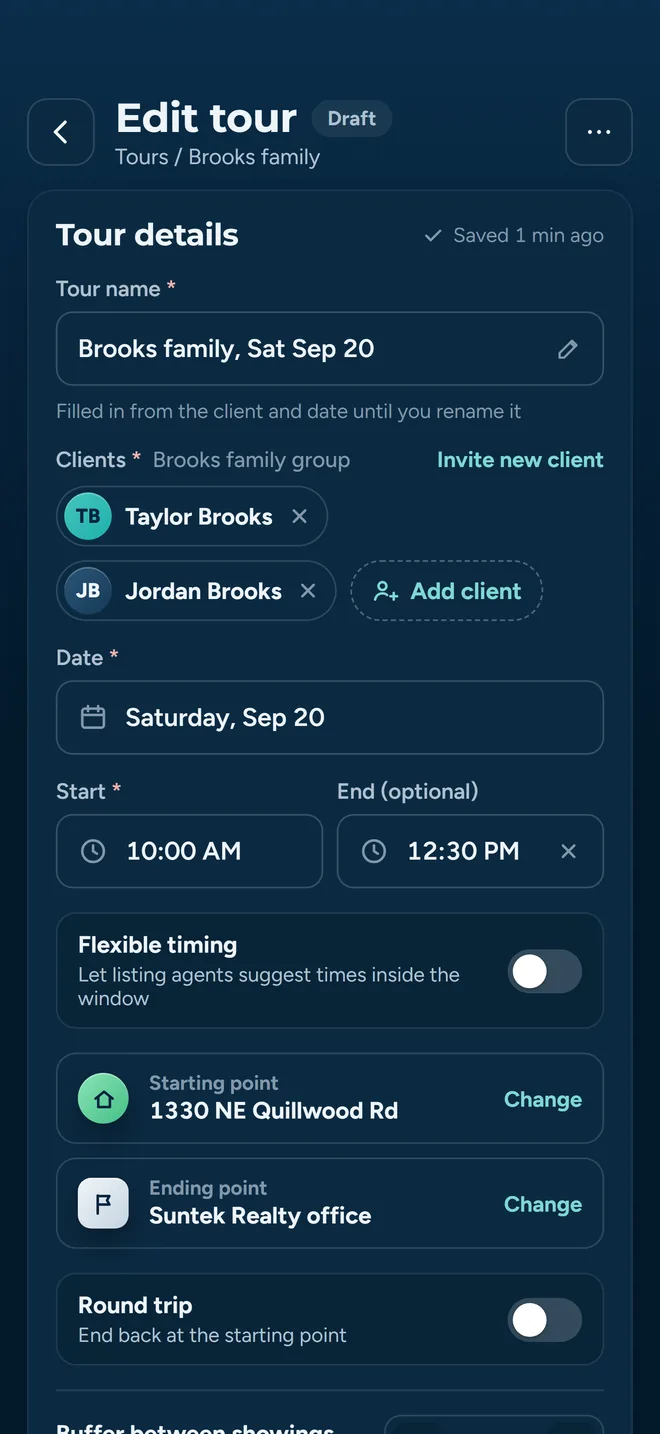
The piece that enforces the sequencing is a toggle in Documents settings called Require Buyer Agreement. Turn it on and tour creation is blocked for any client in the group whose agreement is not fully signed. The client sees the reason on their dashboard, not a dead end. It is a self-imposed guardrail, the only kind that survives a busy Friday.
A sequence that holds up
- Mention the agreement in the first real conversation, before anyone asks.
- Send it while you are building the search, with a message attached.
- Answer the term and compensation questions out loud, with numbers.
- Offer the short form to the one-house buyer instead of arguing.
- Confirm it is fully signed before you schedule anything.
None of that requires software. It requires deciding the agreement is part of how you start with a client, not a hurdle you clear later.
About Time Tours keeps the agreement, the client, and the tour in one place, so the signature happens before the route does.
Get guided setupOne more time, because it matters: the above is practice, not compliance guidance. Your forms and your obligations come from your broker and your state.
Common questions
- Should the buyer agreement be signed before the first showing?
- Standard practice is yes: the agreement is signed before the agent opens a door, not after. Raising it during the first real conversation and sending it while the buyer is still choosing what to tour keeps the signature attached to scheduling rather than to a house the buyer already wants. What is actually required of you varies by state, MLS, and brokerage, so confirm the specifics with your principal broker.
- How do I ask a buyer to sign a representation agreement without scaring them off?
- Name it before they ask, describe it in one plain sentence, and say the term length and the compensation number out loud instead of letting them find it themselves. Buyers react badly to surprise, not to paperwork. The agents who struggle with this are usually the ones raising it in a driveway with a lockbox already in hand.
- What if the buyer only wants to see one house?
- Most brokerages have a short-form agreement scoped to a single property and a short window, and that is the cleanest answer to the one-house buyer. It gives them a low-commitment yes and gives you a written arrangement for that address. If the showing goes well, you replace it with a full-term agreement afterward rather than arguing about the first one.
- Can a buyer sign a buyer representation agreement on their phone?
- Yes. In About Time Tours the buyer opens the document on their own phone or in a browser, reviews the full PDF, fills any fields assigned to them, and signs on the device. When several buyers are on one agreement they sign in order, so the second buyer cannot sign until the first one has finished.
- What happens if a buyer refuses to sign anything?
- Treat it as information rather than a fight. A buyer who will not sign a short, narrowly scoped agreement after you have explained the term and the compensation is usually telling you they are already working with someone else, or that they are not ready to buy. Decide in advance what you will do in that case so you are not making the call in a parking lot.
- buyer agreements
- showings
- client onboarding
- e-signature