What actually makes a showing route efficient
A plain-English guide to how showing routes get optimized: greedy nearest-neighbour ordering, 2-opt cleanup, real drive times, and pinned confirmed stops.
· 6 min read
An efficient showing route is the one with the least total driving time between stops, subject to the appointment times you have already committed to. Two decisions do most of the work: order the stops by real driving time instead of map distance, and treat every already-confirmed showing as a fixed point the rest of the route bends around.
That second half is what separates a showing tour from a delivery route. A delivery driver can visit stops in any order. You cannot. The 2:30 at the house with the tenant and the two dogs was negotiated, and moving it costs a phone call and maybe the showing.
What "efficient" means on a showing day
Not miles. Minutes, and specifically minutes your client spends in the car instead of in a house.
A route can be shorter in distance and worse in every way that matters. What is worth optimizing for, in rough order:
- Total drive time between stops. The number a solver minimizes, and the right primary target.
- Barrier crossings. A river with two bridges, a rail line, a freeway with few on-ramps. Crossing one of these three times is the signature of a bad route.
- Where the day ends. If your client has to be somewhere at five, finishing twenty-five minutes in the wrong direction is not efficient.
- Slack. A route with zero buffer fails at stop three when the lockbox will not open.
Why "just drive to the nearest next house" gets you most of the way
The simplest useful algorithm is one sentence long. Start at your starting point. Of the homes you have not seen yet, go to the closest one by drive time. Repeat until you run out. That is the whole thing, and it has a name: a greedy nearest-neighbour walk.
It works well on showing tours because showing tours are already clustered. A buyer looking at four-bedrooms in one price band across two neighborhoods gives you points that mostly want to be visited in geographic order anyway. Greedy finds that order instantly.
Where it fails is the end of the route. Greedy has no memory and no plan. It takes the cheapest next hop with no thought for what it leaves behind, so the houses it skips early are the ones it drives back for. Picture picking berries: you always walk to the nearest bush, and at the end you are at the far fence with one bush left back at the gate. The last leg of a greedy route is often the longest leg of the day.
What 2-opt does, in plain language
Draw the greedy route on a map with a pen. If any two legs cross each other, that route is provably longer than it needs to be. 2-opt untangles the crossings.
The move is small. Take two legs, cut them, reconnect the four endpoints the other way (which reverses the stretch of stops in between), and keep the change only if total drive time went down. Then look for another pair, and repeat until a full pass finds nothing that helps. The stops never move on the map. Only the order changes, and only when the clock agrees.
Why straight-line distance lies to you
Two homes 1.2 miles apart as the crow flies can be four minutes apart or nineteen. The map does not tell you which.
- A river between them, with the nearest bridge two miles the wrong way.
- A freeway between them, and the nearest interchange behind you.
- A hillside subdivision with one entrance, so the neighbor across the ridge is a ten-minute loop.
- A downtown one-way grid, where the return trip takes a longer path than the outbound one.
That last one matters more than people expect. Straight-line distance is symmetric: A to B always equals B to A. Real driving is not. Use straight-line distance for what it is good at, which is a rough sort of which homes belong in the same cluster. Do not use it to promise a client an arrival time.
The constraint that beats the algorithm: a confirmed time cannot move
This is the part that routing tools borrowed from logistics get wrong, and it is the biggest difference between showing tours and package delivery.
Once a listing agent has confirmed 2:30 at a stop, that stop stops being a variable. If the optimizer decides it belongs second in the route at 11:15, you have not found a better route. You have found a broken appointment, an awkward email, and a listing agent who is slower to answer you next time.
The fix is pinning. A pinned stop is held at its place in the order and the solver routes everything else around it. That means two rules, both of which have to hold or the pin is decorative:
- The greedy pass skips pinned stops entirely and places them back at their original positions afterward, so the free stops arrange themselves in the gaps.
- The 2-opt pass refuses to reverse any stretch of route containing a pinned stop. Reversing a stretch changes when everything inside it happens, which is exactly what a pin exists to prevent.
Pins cost you optimization, and that is the honest tradeoff. Every pin shrinks the set of orders the solver may consider. Pin all six stops and you have not optimized anything, you have priced the order you already chose.
Which leads to the sequencing rule that matters most: confirm the constrained showings first, then fill in the flexible ones around them. Fire off six confirmation requests at once across three neighborhoods, take whatever times come back, and you have already decided your route.
Where the drive times come from, and when to distrust them
A route is only as good as the numbers underneath it. Every pair of stops needs a driving time, and there is more than one way to get one. About Time Tours builds that matrix in three tiers and takes the first that answers:
- Google Distance Matrix, requested server-side in batches. The primary source, and the one that knows about bridges, one-ways, and interchanges.
- OSRM, an open-source routing engine, if the Google request fails. Real road network, different data, similar shape of answer.
- Straight-line distance converted to time at a flat assumed speed, if both of the above fail. A last resort, and a guess.
Tier three deserves a warning label. A flat speed assumption is too slow for a highway run between suburbs and much too fast for six blocks downtown.
More important: none of these tiers predict traffic at your departure time. They give typical driving times, not a forecast of what that corridor does at 4:40 on a Friday. Add your own buffer for the windows you know are bad: school pickup, the bridge at rush hour, the arena on a game day. The algorithm has never heard of the game.
How to build a good route by hand
That is what software does. This is what still belongs to you, and doing it well makes the software's job easy.
- Cluster first, filter second. Group candidates by geography, then decide which ones make the cut inside each cluster. The other way around gives you a shortlist that spans the county.
- Confirm the hard stops before anything else. Tenant-occupied, appointment-only, listing agent must attend, narrow window. These set the skeleton of the day.
- Budget the house and the drive separately. Thirty minutes inside is a reasonable default. Parking, the lockbox, and the driveway conversation are on top of it.
- Cap the day before you route it. Four or five stops for a half day, six to eight for a full one. A ninth home usually costs you the quality of feedback on the other eight.
- Do not cross the same barrier twice. Over the river, back, and over again is a tangle 2-opt would have removed. Fix it by hand if you have to.
- End near the exit. The last stop should sit close to wherever the client is headed next.
- Re-check after every change. Adding one house mid-list does not just add its own leg. It can change the right order for everything after it.
How this works in About Time Tours
The routing above is what the app runs when you optimize a tour, with the coordination attached so the two do not fight each other.
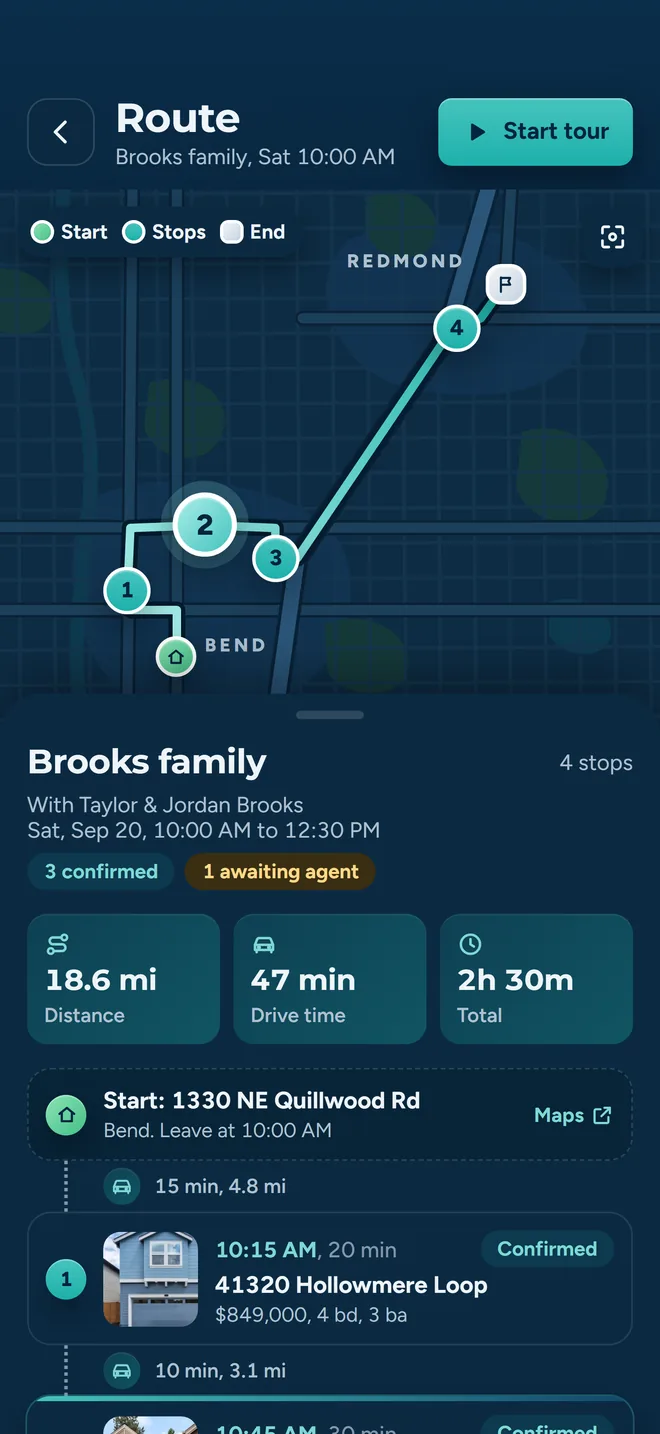
- Stops confirmed by the listing agent are pinned automatically and shown with a lock. The route rebuilds around them, and the manual reorder controls will not move a stop past a locked one.
- You can release a pin when you need to, and the app says plainly that changing the time means re-confirming with the listing agent.
- A keep-my-order mode skips the reordering entirely and just calculates drive times for the sequence you chose, for when local knowledge beats the map.
- Arrival times chain the per-leg drive times with a visit length (thirty minutes by default) and a between-showing buffer (five minutes by default), so the client's itinerary matches the route you built.
- Round trips include the return leg to your starting point in the total.
Build a tour in About Time Tours, let it route around your confirmed times, and see whether the order it picks matches the one in your head.
Get guided setupCommon questions
- What is route optimization for real estate showings?
- Route optimization is putting a set of showings in the order that costs the least total driving time, while respecting any appointment times you have already committed to. It usually works in two passes: a quick greedy pass that walks from each house to the nearest unvisited one, then an improvement pass that swaps pairs of legs to remove crossings. The result is an order, plus an estimated arrival time for each stop.
- Does the shortest route always make for the best showing day?
- No. The shortest route by distance can still be the slowest by time, and the fastest route can still be a bad day. A good showing route also ends near wherever the client needs to be afterward, avoids crossing the same river or highway more than once, and leaves enough slack that one long conversation in a driveway does not collapse the rest of the schedule.
- What happens to a showing that is already confirmed when the route changes?
- It should be pinned, meaning the optimizer treats its position and time as fixed and routes everything else around it. A confirmed time is not a variable: the listing agent, the seller, and possibly a tenant have all agreed to it, and moving it costs a phone call. In About Time Tours, stops confirmed by the listing agent are pinned automatically and marked with a lock, and the route is built around them.
- Is straight-line distance good enough for planning a tour?
- Not for scheduling. Two homes 1.2 miles apart in a straight line can be four minutes apart or nineteen, depending on bridges, freeway interchanges, one-way grids, and subdivisions with a single entrance. Straight-line distance is also symmetric while real driving is not. It is fine as a rough sort of which homes are near each other, but arrival times should come from a driving-time source.
- How many stops should you put in one showing tour?
- Four or five is a comfortable half day; six to eight is a realistic ceiling for a full one, assuming roughly thirty minutes inside each home plus drive time and a short buffer between them. Adding a ninth stop usually costs you feedback quality on the other eight, because buyers stop distinguishing between homes once they are tired. Cap the list before you route it rather than hoping optimization will make an overloaded day fit.
- route optimization
- tour routing
- drive time
- showing schedule