How to get listing agents to confirm showings faster
Most showing requests stall because they cannot be answered in one action. What to put in the message, when to send it, and how to absorb a counter-offer.
· 6 min read

Listing agents confirm fastest when your request can be answered in one action. Put the address and MLS number, the exact date and time window, and your name, brokerage and phone into one message, and give them one obvious way to say yes, no, or here is a better time. Most slow confirmations are not reluctance. They are requests that cannot be answered without asking you something first.
Why the call-then-text-then-voicemail chain makes you slower
The instinct when a request goes unanswered is to add channels. Call. No answer. Text. Voicemail summarizing the text. By dinner you have three artifacts, none containing the whole request, and the listing agent has to reassemble it before answering any of them. Every channel you add costs the recipient something:
- A voicemail cannot be answered from the car between their own showings. A text can.
- A call that lands mid-showing is an interruption, and interruptions get deliberately forgotten.
- Three partial messages force them to reconstruct the request. One complete message does not.
- Repeated contact reads as pressure, and pressure makes people defer rather than decide.
Pick the one channel that carries the whole request, send it once, and set yourself a follow-up window.
What a showing request has to contain to be answered in one reply
A listing agent reading your request is asking four things: which property, when, who is coming, and is anything unusual. Answer all four and they can respond in fifteen seconds from a parking lot. Answer three and you get silence, because a partial answer costs them a message they would rather send later.
- The property, unambiguously. Street address with unit number, plus the MLS number. An agent with three listings on one street will not guess.
- The exact window, not just a start time. "2:30 to 3:00 PM" tells them whether it collides with the 3:00 they already have.
- The date with the day of the week. "Friday, October 16" survives being forwarded. "10/16" does not.
- Who you are. Name, brokerage, cell. Not your client's name; a listing agent does not need it to grant access.
- Anything that changes the answer. Occupied or vacant matters. So does a pre-approved buyer touring five homes that afternoon.
- One clear way to respond. A link, or "reply Y". One action, not "let me know".
When do listing agents actually read these?
There is no published figure on this, and you should distrust anyone who quotes you one. What holds up is the shape of the day:
- Early morning, before showings start. Most agents triage a night of messages here. A request sitting there at 7:00 AM gets read.
- Roughly 11:00 to 4:00 is the dead zone. They are in the car or inside someone else's house. Messages sent then get seen and deferred, which is worse than unread.
- Late afternoon, after the last showing. The second window, and the shorter one.
- After 6:00 PM for a next-day showing is a coin flip. If the tour is tomorrow, that request should have gone out two days ago.
Practical rule: send every request in one batch the moment the tour exists, even a week out. Get into the queue before the day fills.
Make the no easy and the yes gets faster
Silence is almost never a soft yes. It is usually a listing agent who cannot confirm yet, because the sellers have not answered or there is a competing showing, and who is postponing the awkward part. A decline at 8:00 AM gives you a day to backfill. At 4:30 PM, or never, it wrecks the route.
- Say the word. "A no is fine, I just need to know by tonight" removes the social cost of turning you down.
- Give a deadline with a reason attached. "I am locking the route at 5" is actionable. "ASAP" is not.
- Offer the alternative in the same breath. "If 2:30 does not work, what does?" turns a decline into a reschedule at no extra cost.
- Never make them explain. You do not need the reason, and asking adds a step between them and the send button.
What to do when a request goes unanswered
Set the ladder before you need it:
- Send it and log the time. Do nothing else that day.
- Next morning, one follow-up in the same thread, so the original request is still visible above your nudge.
- Same afternoon, switch channels once. Text if you emailed, call if you texted. Leave a voicemail that is a summary, not a request.
- Then try the co-listing agent. Listings often carry a second name, and the second name frequently answers.
- Then treat it as a no. Backup slot, tell your buyer it is unconfirmed, keep driving.
Handling counter-proposals without collapsing the rest of the day
A counter-proposal is a good outcome that feels like a bad one. Someone said yes to the property and no to the clock. Handle it badly and a 20-minute shift cascades through four other stops.
- Decide the accept threshold in advance. Mine: if the proposed time fits the existing gap plus the drive, accept immediately and stop thinking about it.
- Never move a confirmed stop for an unconfirmed one. A confirmed showing is a commitment to another agent and their seller.
- Move the flexible stops first, and reorder before you re-time. Swapping two nearby stops often absorbs 30 minutes without touching anyone's confirmed window.
- If it truly does not fit, counter once with two specific times. An open question is another decision handed back to them.
- Re-confirm anything you moved. A stop you shifted is no longer confirmed, whatever your calendar says.
And accept fast. A counter-proposal that sits for four hours often expires, because the listing agent filled the slot with whoever answered first.
How the confirm, decline and counter-propose flow works in About Time Tours
Send a showing request from the Confirm Tour screen and About Time Tours creates a confirmation record for the stop, then emails the listing agent. The subject line is the address plus the date and time range, so it reads at a glance in a packed inbox. The body carries the property (address, price, beds, baths, square feet, MLS number), the requested date and full time range with time zone, and your name, brokerage, phone and email. Your client's name is not in it. If the listing agent has a usable phone number on file, a short SMS goes out with the same details and the same link.
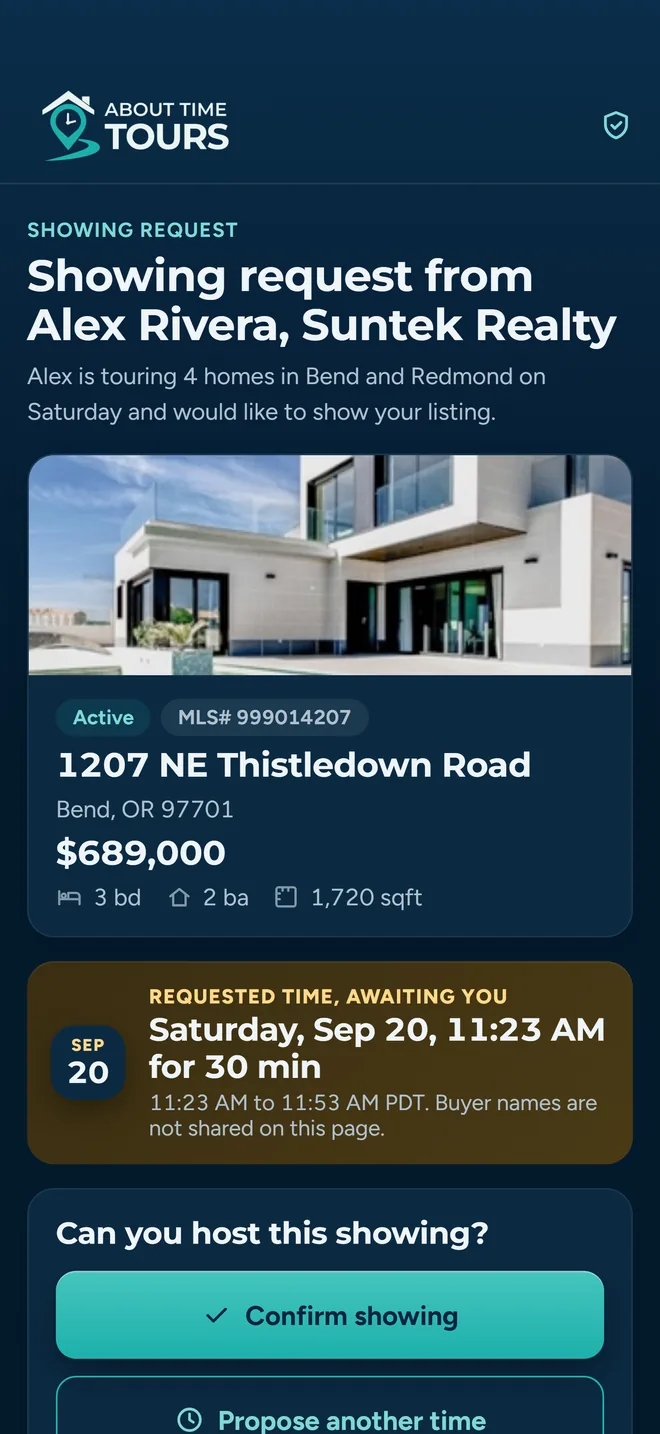
The link opens a page with one primary button, Confirm Showing, and under it: "Can't make it? Decline or propose a new time." That opens a time picker and an optional note box. No login, no account, no app download.
What happens next depends on what they attach:
- A plain confirm. The stop is marked confirmed and you get a push notification naming the address and time.
- A decline with a proposed time, a note, or both. The backend classifies it as a counter-proposal, not a decline. The stop moves into a reschedule state instead of a dead one, and your notification names the suggested time next to the one you asked for.
- A bare decline with nothing attached. That, and only that, is terminal. The stop is marked declined and flagged so it stands out in the list.
Each stop then carries one of: Not Sent, Pending, Opened, Contacted, Needs reschedule, Declined, Confirmed. Opened comes from a tracking pixel in the email, and it is the most useful state on that list: it separates "they have not seen it" from "they have seen it and are avoiding it".
Accepting a counter-proposal is one action: the stop moves to the proposed time, is marked confirmed, and the listing agent is told their time was taken. Countering back sets your new time, resets the stop to pending, and re-sends the request. When you re-optimize the route afterward, confirmed stops stay pinned unless you deliberately release them, so fixing one reschedule does not quietly move showings you already committed to.
None of the first half of this needs software. A complete request, sent once, at an hour people read, with an explicit invitation to say no, beats a day of phone tag. Tooling matters at the next layer: knowing which of eleven requests was opened, and absorbing a counter-proposal without rebuilding the afternoon by hand.
About Time Tours sends the showing request, shows you which ones were opened, and turns a listing agent's counter-proposal into a one-tap reschedule that leaves your confirmed stops where they are.
Get guided setupCommon questions
- What should a showing request include?
- A showing request should include the full street address with unit number, the MLS number, the date written out with the day of the week, an exact time window rather than just a start time, and the requesting agent's name, brokerage and cell number. It should also give one clear way to respond, such as a link or a reply-Y instruction, so the listing agent can answer without composing a message. Leave the buyer's name out of it; a listing agent does not need it to grant access.
- How long should I wait before following up on a showing request?
- Send the request, log the time you sent it, and do not follow up the same day. The next morning, send one follow-up inside the same thread so the original request is still visible above it. That afternoon, switch channels once: text if you emailed, call if you texted. After two days with no answer, treat it as a no, move the property to a backup slot, and route around it.
- What time of day are listing agents most likely to respond to showing requests?
- Early morning before showings begin and late afternoon after the last one are the two windows when most agents triage their messages. Roughly 11 AM to 4 PM is a dead zone, because agents are in the car or inside other people's houses, so requests sent then get seen and deferred. There is no published statistic on this, so treat it as a working rule rather than a measurement, and send requests the moment the tour exists rather than the night before.
- Is it better to call or text a showing request?
- Send one written message rather than calling. A text or an email carries the whole request and can be answered from a parking lot between showings, while a call requires the listing agent to be free at the exact moment you dial. A voicemail is the worst of the three because it cannot be answered without a callback. Save the phone call for the second follow-up, after a written request has gone unanswered for a day.
- What should I do if the listing agent proposes a different showing time?
- Decide your accept threshold before the message arrives: if the proposed time fits inside the existing gap plus the drive, take it immediately and stop deliberating. Never move an already-confirmed stop to accommodate an unconfirmed one, and shift flexible stops such as vacant listings and lockbox access before occupied ones. If the proposal genuinely does not fit, counter once with two specific alternatives rather than asking what else works, and re-send confirmation requests for any stop whose time you changed.
- showing requests
- listing agents
- confirmations
- scheduling
- phone tag