How to schedule multiple showings in one day without losing the afternoon
Request showings 48 to 72 hours out, sequence stops by drive time instead of buyer excitement, and build buffers that survive parking, lockboxes and lingering.
· 7 min read
Request your showings 48 to 72 hours out, keep the day inside one geographic cluster, and budget each stop at 30 minutes inside the house plus real drive time plus 5 to 10 minutes of slack. Order the stops by drive time, not by how excited your buyer is about them. Days that fall apart rarely fail on the houses. They fail in the transitions between them.
Four showings is a morning. Seven is a full day and a tired buyer. The difference between finishing at 2:00 and losing the whole afternoon is decided before you send the first request.
How far ahead should you request showings?
Forty-eight to seventy-two hours is the working target. Long enough for a listing agent to reach an owner, short enough that the listings still exist in the form you saw them.
- Vacant with lockbox access. Often same day, sometimes an hour of notice. These are your flex stops and your bench.
- Owner-occupied. Twenty-four hours is the polite floor. People need to get the dog out and the dishes off the counter.
- Tenant-occupied. The longest lead time on the tour. Notice has to reach the tenant before the listing agent can confirm anything, and that clock is not yours to compress.
- Agent-present or appointment-only. You are scheduling two working calendars. Ask for the time first and build the day around the answer.
Going out further than a week has its own failure mode. The house you built the day around goes pending on Thursday and you are re-planning Friday night.
Always request an exact window. Saturday between 1:00 and 1:45 gets you a yes or a counter. Saturday afternoon gets you silence, because you just handed the listing agent your scheduling work.
Sequence by geography, not by buyer excitement
Your buyer will hand you a ranked list. That ranking tells you what to cut. It tells you nothing about what order to drive.
- Pin every candidate on a map before you request a single time. Do this even for four houses. The map usually kills one stop on its own.
- Cut or defer the outliers. A house 20 minutes outside the cluster costs 40 minutes of driving plus the attention your buyer burns in the car.
- Find your anchors. A stop with a fixed time, like the agent-present showing at 1:00, is immovable. Build around it rather than fight it.
- From your starting point, go to the nearest unvisited stop, then the nearest one from there, and keep walking the list that way.
- Now look at your two worst legs. If swapping a pair of stops shortens the total drive, swap them and check again. Two or three passes is enough.
- Check the last leg. A route that ends 35 minutes from where your buyer parked their own car ends in a bad mood.
That is a nearest-neighbor route with a couple of manual improvement swaps. Good enough up to about five stops.
What is a realistic buffer between showings?
Three quantities get collapsed into one number, and that is where schedules break. Drive time, access time and human time do not vary together.
- Drive time. What the route takes at the hour you will actually drive it. Mid-morning and 4:30 are two different cities.
- Access time. Lockbox, keypad, app, or gate. Three minutes when it works, ten when the app cannot find the box and you are calling the listing agent from the porch.
- Walk-through time. Twenty to thirty minutes for a typical resale with one buyer. Add ten for a second decision maker, fifteen more for parents, a contractor, or kids.
- Exit time. The client standing in the driveway talking about the kitchen. It is real, it is about five minutes, and it is in nobody's schedule.
Practical default: 30 minutes inside, plus real drive time, plus 5 to 10 minutes of slack per transition. Add up the whole day before you send anything. If the math says you finish at 4:40, cut a stop now rather than at 3:15 in front of your client.
Why 45 minutes between suburban stops is not 45 minutes downtown
In the suburbs, drive time is the variable and the overhead is tiny. You park in the driveway and you are at the door in twenty seconds. If the drive comes in short, you get the time back.
Downtown that inverts. The drive is eight minutes and the overhead is everything else: finding the garage, paying for street parking, lobby check-in, waiting on an elevator, a fob that only works for certain floors, then all of it in reverse. That overhead does not compress when you are late. It is the most rigid part of the day.
- High-rise or secured building: add 10 to 15 minutes per stop on top of the walk-through, before you commit to a time.
- Gated community: get the gate code with the confirmation, not at the gate.
- Rural: the last mile is gravel, mapping data is optimistic about it, and cell service may be gone exactly when you need the lockbox app.
- Two units in the same building: the cheapest pair of showings you will ever schedule. Stack them back to back.
What do you do when a listing agent will not confirm?
This is the most common single cause of a wrecked afternoon, and the fix is procedural rather than diplomatic.
- Set a cutoff. Anything not confirmed 24 hours out comes off the primary route. Make it a standing rule so you are not deciding under pressure on Friday night.
- Follow up once, by text. Listing agents live in text. A second email is not a follow-up, it is the same email.
- Ask for a counter instead of repeating yourself. If 2:15 does not work, what time does? That is a reply they can send with one thumb.
- Escalate to the brokerage front desk if the listing is worth it. Someone in that office can reach that agent.
- Then cut it and fill the hole from your bench. A gap in the middle of a tour costs more than a substitution does.
Treat unconfirmed as declined. An unconfirmed stop you drive to anyway is a locked door in front of your client, and that costs more than the house was worth seeing.
Keep a bench
Every multi-stop day should carry two or three backup listings, picked before you leave rather than searched for from the car.
- Inside the cluster, ideally sitting between two stops you already have.
- Vacant or lockbox access, so they can be added without a new negotiation.
- Status re-checked the morning of. A bench listing that went pending Thursday is not a bench listing.
- Already inside the buyer's stated criteria, so you are not selling them on it in a driveway.
Decide your collapse plan too. If you are 25 minutes behind after stop three, which stop gets cut? Picking that on the sidewalk with the client watching is how agents cut the wrong one.
The morning-of pass
- Re-check the status of every listing on the route. Pendings happen overnight.
- Text each confirmation one line: confirming 2:15 at 1442 Elm today. This catches problems that email would not.
- Send the client the itinerary with addresses and arrival times, plus where to park at the first stop.
- Put every access detail in one place you can read one-handed: gate code, lockbox type, side door, the dog.
- Have the listing agents' mobile numbers on your phone, not buried in an email thread.
Where automatic routing takes over
Hand-sequencing holds up to about five stops. Past that, the real cost is not the driving. It is that changing one stop cascades into the arrival time of every stop after it, and you redo the arithmetic every time a listing agent counters.
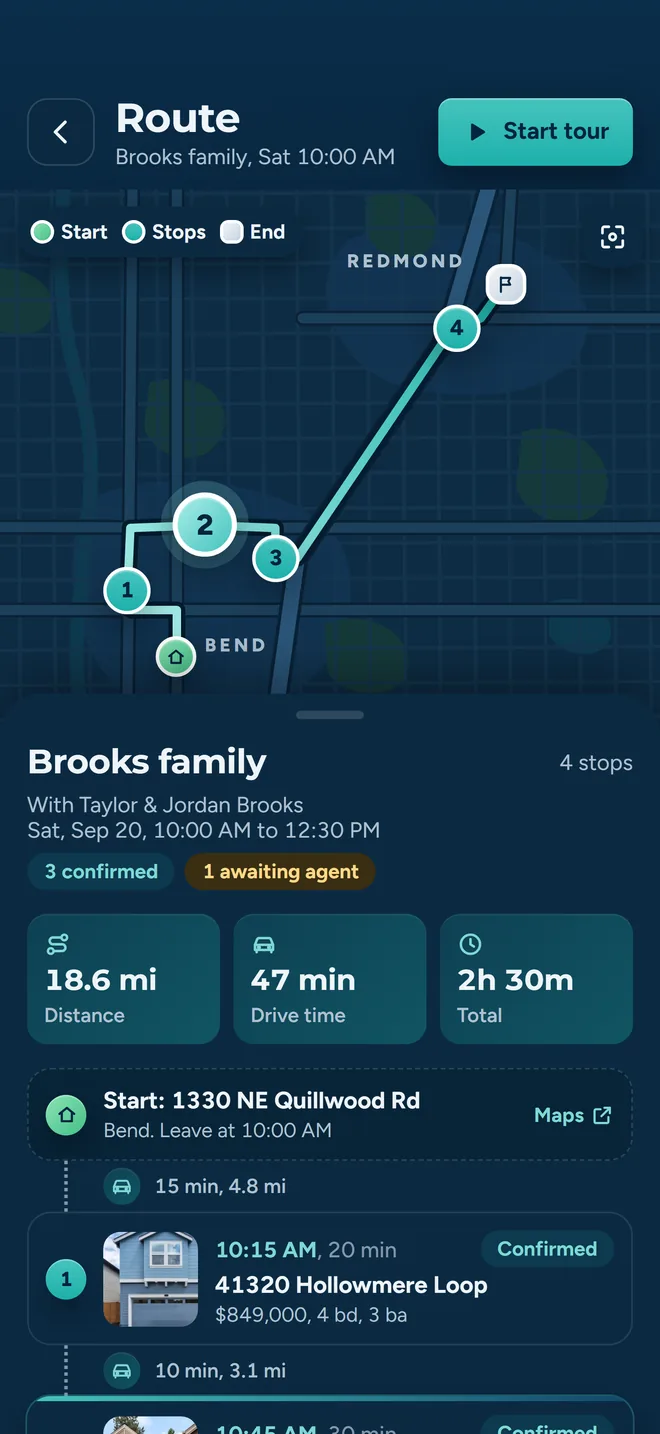
That is the part About Time Tours automates. It pulls driving times between every pair of stops from Google Distance Matrix, falling back to OSRM and then straight-line estimates if that call fails, orders them with a nearest-neighbor pass plus 2-opt improvement, and chains the schedule forward: arrival, visit, buffer, drive, next arrival.
- Visit duration starts at 30 minutes and is editable per stop. The between-showing buffer starts at 5 minutes, set per tour or as your account default. The schedule, the saved times, and the message to the listing agent all read the same number.
- Confirmed stops are pinned. Once a listing agent has confirmed 2:15, re-optimizing routes the other stops around that one instead of moving it.
- Showing requests go to each listing agent with confirm and decline links. They can decline, propose a different time, or leave a note, and a counter-proposal keeps the stop in a reschedule flow rather than dropping it.
- A conflict check looks for stops other agents have already booked at the same listings that day, and an auto-shift option moves your time past the overlap.
- Change the tour start time and previously confirmed stops go back to pending on purpose, because the time you promised the listing agent is no longer the time you plan to arrive.
- Property search runs on MLS data in supported Oregon and Southeast Florida markets. The listing cache refreshes about every 15 minutes, and stop statuses are re-checked when you open the tour.
The judgment stays yours. No routing engine knows the buyer's mother is meeting you at the third house, so that stop needs 45 minutes. Software just keeps the arithmetic honest while you make those calls. Plan the transitions as carefully as the houses. The showings are the easy part.
About Time Tours puts route optimization, listing agent confirmations, and client itineraries in one place.
Get guided setupCommon questions
- How far in advance should I schedule showings?
- Aim for 48 to 72 hours before the tour. That is long enough for a listing agent to reach the owner and short enough that the listings are unlikely to change status before you arrive. Vacant homes with lockbox access can often be added the same day, while tenant-occupied homes usually need the longest lead time because notice has to reach the tenant first.
- How many showings can you realistically do in one day?
- Six to eight is a realistic ceiling for a full day inside one geographic cluster, and four or five makes a comfortable morning. The limit is usually buyer fatigue rather than driving. After the fifth or sixth house, most buyers stop forming clear opinions and start blending the properties together in memory.
- How much time should I leave between showings?
- Budget three things separately: roughly 30 minutes inside the house, the actual drive time between the two addresses, and 5 to 10 minutes of slack for parking, lockbox access, and the client who lingers. In suburban areas the drive time dominates. Downtown or in a secured building, add another 10 to 15 minutes per stop for garage parking, lobby check-in and elevators.
- What should I do if a listing agent will not confirm a showing?
- Set a cutoff at 24 hours before the tour and treat anything still unconfirmed as declined. Follow up once by text rather than sending a second email, and ask for a counter-offer, such as 'if 2:15 does not work, what time does?', instead of repeating the original request. If it is still not confirmed at your cutoff, replace it with a backup listing inside the same cluster rather than leaving a hole in the route.
- Should I show the buyer's favorite house first or last?
- Usually second to last. Buyers judge each home against the one they just walked out of, so a strong contender benefits from a late slot, while the final stop absorbs the fatigue and any schedule slippage. If the day is at risk from weather, a shaky confirmation, or a hard stop on the buyer's calendar, show the must-sees early instead and accept the weaker comparison.
- showing logistics
- scheduling
- tour routing
- listing agents