The pre-tour checklist buyer's agents actually use
A working pre-tour checklist for buyer agents: what to confirm the day before, what to verify the morning of, what to carry, and how to capture feedback.
· 6 min read

The pre-tour checklist for a buyer's agent runs in two windows. The day before, you chase confirmations on every stop, verify access rather than just permission, confirm the buyer agreement is fully signed, and send an itinerary with a real arrival time per house. The morning of, you re-check listing status, check drive times and parking against today's traffic, and decide in advance which house you drop if you fall behind.
Tours go wrong in a small number of predictable ways: an unconfirmed door, a lockbox you cannot open, a buyer who expected four houses and got seven, and feedback that evaporated by dinner. Everything below targets those four.
Why the day before is the real deadline
Listing agents answer showing requests during working hours. A request sent at 8pm lands in an inbox opened at 8am, which is when you need the answer. Send by mid-afternoon and you get a same-day yes, a no you can still route around, or a counter-proposal you have time to accept.
Occupied homes are the harder constraint. Many require 24 hours notice to a tenant. If your request lands at 7pm for a 10am showing, the decline is arithmetic, not attitude.
The day-before checklist
- Freeze the list by mid-afternoon. Tell the buyer the set is final. Late additions change drive order and can invalidate confirmations you already have.
- Send one confirmation request per stop, with a specific arrival time. Not a window. A listing agent can say yes to 10:40am. Nobody can say yes to sometime that morning.
- Log how and when you reached out for each stop. Chasing three unanswered requests at 9pm, memory is not a system.
- Handle counter-proposals the same day. An offer of 11:15 instead of 10:40 is a yes with a condition, and it moves the rest of the route with it.
- Verify access, not just permission. Confirmation means you may enter. It does not mean you can. Note the box type, gate code, alarm, pets, and whether the listing agent must be there.
- Confirm the buyer agreement is fully signed. Sent is not signed. On a tour with two buyers, partially signed is not signed either.
- Send the itinerary with a per-house arrival time and an end time. Buyers behave differently when they can see house six is at 2:15 and the day ends at 3:00.
- Set expectations in writing, once. Time per house, what happens if a seller cancels, whether they can bring a parent, and how much of the day is driving.
- Look at the route by drive time, not distance. Five miles across a river at 4pm is not five miles.
- Pad between stops. Parking, walking in, working a lockbox and the porch conversation add up. Five minutes per stop is a floor, ten if the homes are urban or gated.
- Decide the cut line now. If you are twenty-five minutes down after stop four, which house drops? Decide that while calm, not in a driveway.
How do you verify lockbox and access before showing day?
Read the MLS showing instructions and private remarks, not the public description. Those two fields hold the real access details, and they are agent-only for a reason: they routinely contain gate codes and box combinations. If both are blank, call the listing agent rather than assuming a Supra box on the front door.
- Box type and where it sits. A combo box on a side gate is a ten-minute problem if you learn that at the front door.
- The combo code in writing if it is not an electronic box, not read to you while you drive.
- Gate, building, or garage codes, and whether they rotate.
- Occupied or vacant, and how much notice the occupant requires.
- Pets: contained, loose, or a hard no. Ask specifically about crated dogs and cats that bolt.
- Alarm: a code, or the seller disarms it, and who to call if it goes off.
- Whether the listing agent must be present, which turns a flexible stop into a fixed appointment.
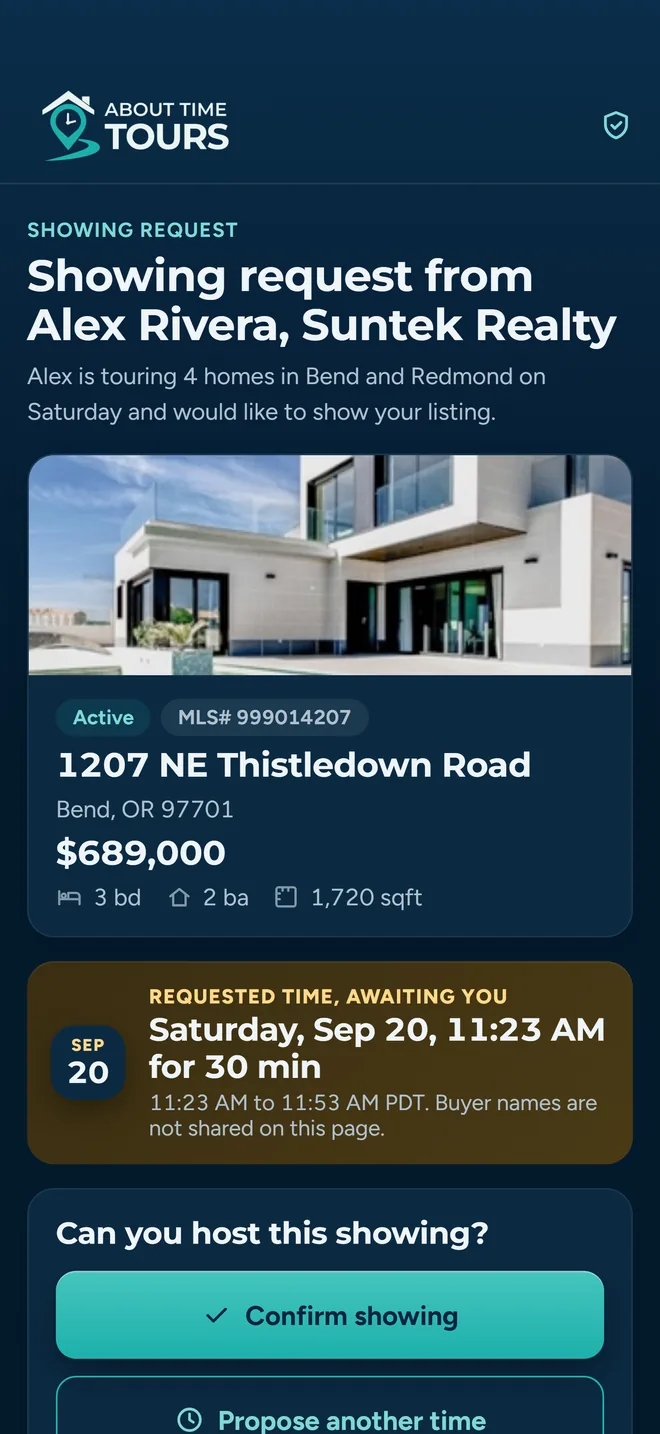
In About Time Tours, those two fields render on the stop itself in an agent-only panel marked do-not-share, so the lockbox line is on the screen you already have open. Each stop keeps its own status, so pending, confirmed, declined and counter-proposed are visible at a glance, not reconstructed from your sent folder.
The morning-of checklist
- Re-check status on every listing. Homes go pending overnight. Showing a house that accepted an offer at 9pm is an avoidable, memorable embarrassment.
- Re-read your confirmations. Every stop has an answer, matching today's times not yesterday's.
- Send the buyer one message: meeting point, start, end, number of homes. One message, not a thread.
- Check drive times against this morning's traffic. Last night's estimate assumed typical conditions. Construction and a bridge lift are not.
- Look at parking before you leave. Thirty seconds per stop in satellite view: narrow streets, no driveway, permit blocks, meters, gated lots. Parking is how a tour slips five minutes at a time.
- Set the navigation app you will actually use and load the first address. Fumbling for directions with the buyer beside you sets the tone.
- Confirm the first door will open. If a stop fails, make it the one you have the most time to fix.
- Load the car from the list below, and charge everything.
- Restate the cut line. Which house drops, and when you make that call.
What to carry
- Lockbox credentials verified this morning, and listing agents' direct numbers within reach.
- A battery pack. Lockbox apps, navigation and photos flatten a phone by house five.
- Shoe covers, more pairs than people on the tour.
- A tape measure. Buyers ask about the couch and the second bedroom every single time.
- A flashlight for crawlspaces, attic hatches and panel boxes.
- Water, and a snack if children are coming.
- A printed itinerary, the answer to a dead phone.
- Copies of anything unsigned, and a pen that works.
How do you capture feedback while it is still fresh?
At the door, before the car. The half-life of a buyer's opinion is about one house. By stop four, houses one and two have merged into a single vague memory of beige, and whatever you write that evening is fiction.
Capture it per property and per buyer. Two buyers rarely agree, and averaging them destroys the only interesting thing you collected. A couple that splits three to two across five houses is telling you something a shared note will never show.
- Ask before you leave the driveway, on the sidewalk, not with the engine running.
- Ask each buyer separately, even a quick in-or-out, before they hear the other's answer.
- Record the objection, not the score. A no is useless a week later. A no because the third bedroom opens off the kitchen is a search filter for tomorrow.
- Note what they lingered in. Where people slow down is more honest than what they say.
- Rank against the last house immediately. Better or worse than the previous stop is a question buyers answer accurately. Rate it out of ten is not.
Tour execution in About Time Tours keeps an interested or not-interested mark and a notes field per client per stop, and prompts for every buyer before it moves to the next stop, so passing on the question is a deliberate act rather than an oversight. The driveway is the only moment the answer is reliable.
The follow-up window
The recap goes out the same evening, while the houses are still distinct. It has three jobs: name the front-runner, restate anything that changed about the buyer's criteria, and give a next action with a date on it.
- Same evening: ranked recap to the buyer, each objection quoted back in their own words. It is what stops them re-litigating house two on Thursday.
- Within 24 hours: feedback to every listing agent, including the declines. It is the cheapest professional currency there is, and it is why your requests get answered first.
- Within 24 hours: update the saved search. If three of five homes died on the same objection, that objection is a filter now.
- Within 48 hours: if there is a front-runner, get back in it or get a decision. Enthusiasm has a shelf life of days.
- Before the next tour: re-read these notes. The second tour should look different from the first.
None of this needs software. A clipboard and a disciplined hour the afternoon before beats a badly run tool. What software should remove is the bookkeeping: which stops are confirmed, who countered, and whether the route still works afterward. About Time Tours orders stops by real driving time, pins confirmed stops so re-optimizing cannot move them, and collects per-client feedback at each door. MLS search covers supported Oregon and Southeast Florida markets. Walkthrough: plan and run a tour.
About Time Tours gives buyer's agents tour building, routing by real drive time, listing-agent confirmations, and per-stop feedback in one place.
Get guided setupPrint it, or keep it open the afternoon before your next tour. The day-before list is the one that matters. Nearly everything that goes wrong on showing day was decided by 4pm the day before.
Common questions
- What should a buyer's agent do the day before a showing tour?
- Freeze the property list by mid-afternoon, send an individual confirmation request for every stop with a specific arrival time, and verify access details on each one: lockbox type, gate codes, tenant notice, pets, alarm. Confirm the buyer agreement is fully signed, not just sent. Then send the buyer an itinerary with a per-house arrival time and a stated end time.
- How far in advance should you confirm showings with listing agents?
- Send confirmation requests by mid-afternoon the day before at the latest, and 24 to 48 hours out for occupied homes or anything with a tenant. A request sent at 8pm the night before competes with dinner and often gets answered after you have already left the office. Occupied listings frequently require 24 hours notice to the occupant, so a late request is a decline you caused yourself.
- Do you need a signed buyer agreement before showing homes?
- In most US markets since August 2024, yes: an MLS-participating buyer's agent must have a written buyer representation agreement in place before touring a home with a buyer. Check your state and MLS rules for the exact scope; this is a description of common practice, not legal advice. Operationally, the thing to verify is that the agreement is fully signed by every buyer on the tour, not merely sent or partially signed, because a partially signed agreement is the same as no agreement at the door.
- How do you verify lockbox and access before showing day?
- Read the MLS showing instructions and private remarks on each listing rather than the public description, and note the box type, its location on the property, and any gate or alarm code. If those fields are blank, call the listing agent instead of assuming a Supra box on the front door. Confirm whether the home is occupied, whether pets are contained, and whether the listing agent must be present.
- How soon after a tour should you follow up with the buyer?
- Send the recap the same evening, while the houses are still distinct in the buyer's mind, and send feedback to each listing agent within 24 hours. The recap should name the front-runner, restate anything that changed about the buyer's criteria, and give a next action with a date attached. Waiting two days means re-teaching the buyer their own tour.
- showing checklist
- tour prep
- buyer agents
- showing logistics
- client feedback